95% of AI pilots fail — not because AI can’t think, but because it can’t act.
The bottleneck isn’t model capability. It’s infrastructure capability.
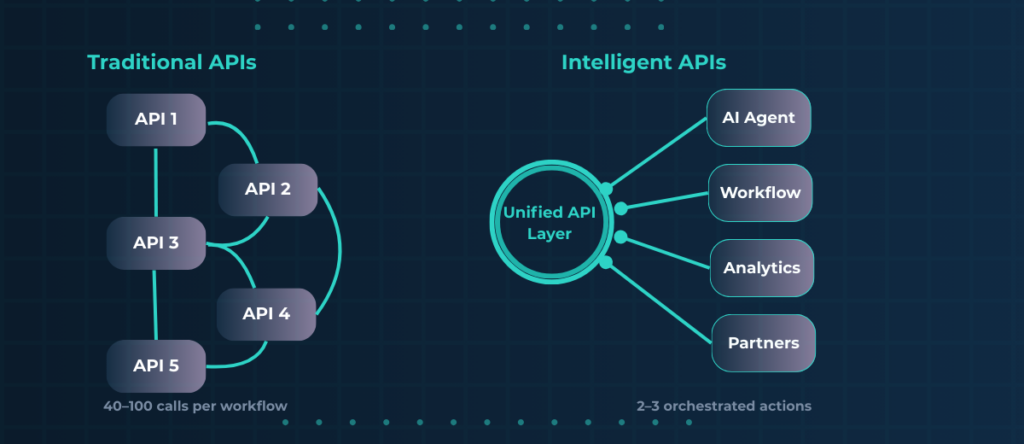
95% of generative AI pilots fail to deliver rapid revenue acceleration.
That’s not a typo. It’s the finding from MIT’s Project NANDA, and it matches what enterprise IT leaders are experiencing firsthand. The number of companies abandoning most AI initiatives jumped from 17% in 2024 to 42% in 2025. Two-thirds of organizations remain stuck in pilot stage, unable to scale AI enterprisewide.
The common explanation? AI isn’t ready. Models hallucinate. Use cases aren’t clear.
The actual problem? AI can reason. AI cannot act. The bottleneck isn’t model capability. It’s infrastructure capability.
The Integration Tax on AI
Here’s what happens when an enterprise tries to deploy an AI agent that actually does something—processes a loan application, updates customer records, triggers a payment.
The agent needs to call APIs. Not one API. Dozens.
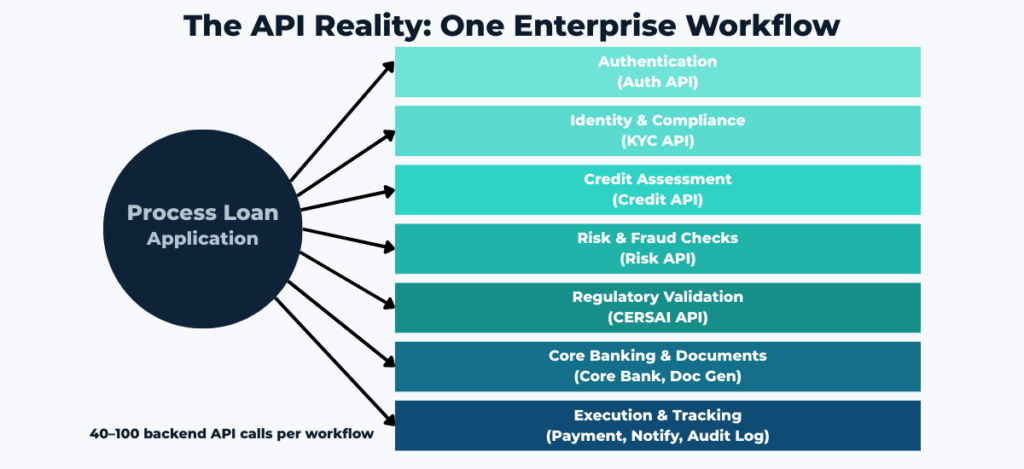
A typical enterprise workflow requires 40-100 backend API calls. Each call needs authentication, error handling, retry logic, and monitoring. Each integration was built by a different team at a different time with different conventions.
The average enterprise uses 250-500+ applications. 71% of those applications remain unintegrated—a number that hasn’t budged in three years. Only 2% of organizations have integrated more than half their apps.
The result? 39% of developer time goes to designing, building, and testing custom integrations. 70% of AI project engineering effort gets consumed by integration work, not AI work.
This is the integration tax. And it’s killing AI projects before they start.
Why Traditional APIs Break AI
Enterprise APIs were built for human developers, not AI agents.
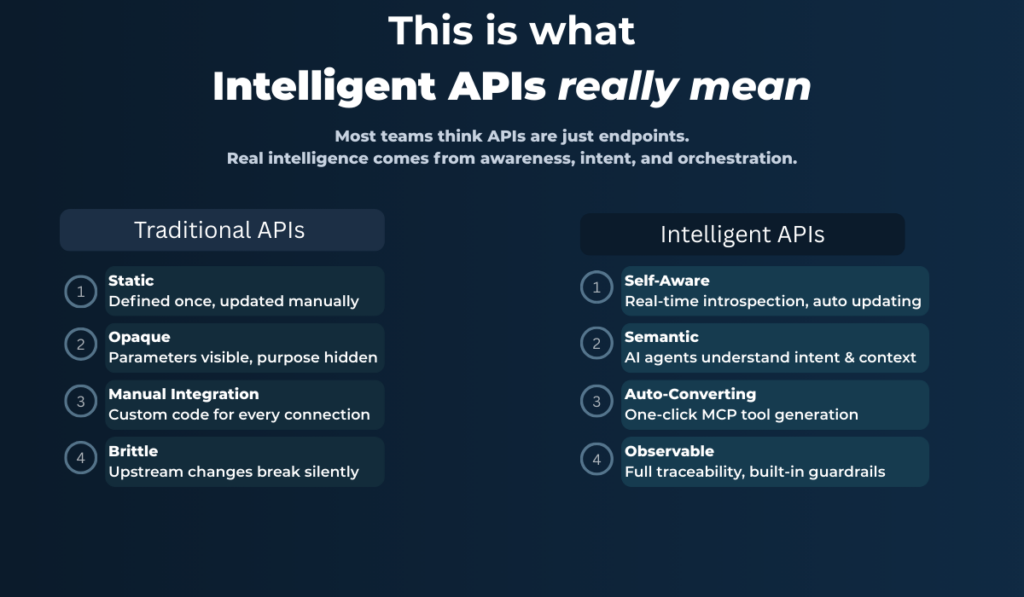
Traditional APIs were built for human developers. Intelligent APIs are built for AI agents.
Traditional APIs are:
- Static. Defined once, updated manually, documented (maybe) in separate systems that drift from reality.
- Opaque. An AI agent looking at an API endpoint sees parameters and types. It doesn’t see purpose, constraints, or relationships to other endpoints.
- Manually integrated. Every connection requires custom code. Every workflow requires orchestration logic built from scratch.
- Brittle. Change one upstream API and downstream integrations break silently.
AI agents need something fundamentally different. They need APIs that explain themselves—what they do, when to use them, how they relate to other capabilities, what guardrails apply.
They need Intelligent APIs.
What Makes an API “Intelligent”
An Intelligent API isn’t just a better-documented endpoint. It’s a new architectural paradigm.
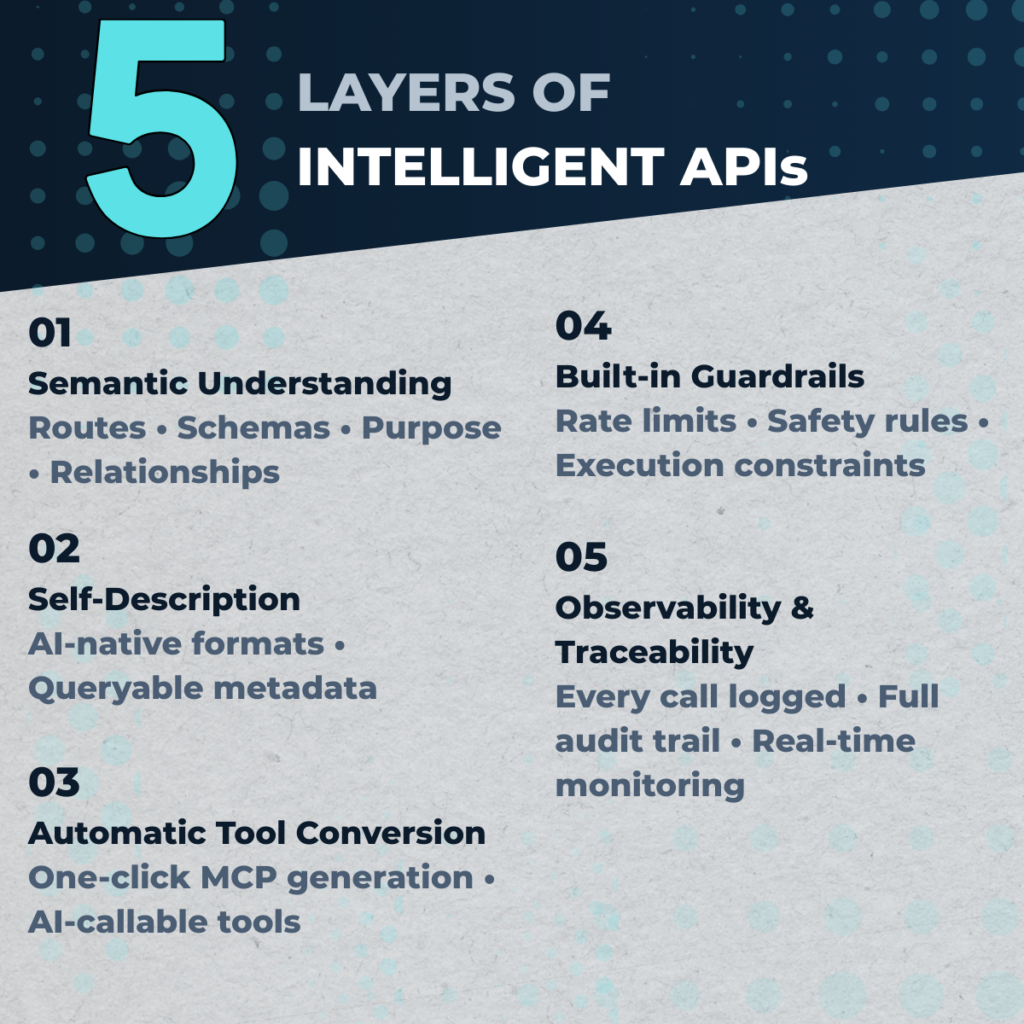
Intelligent APIs transform static endpoints into AI-native, self-describing, orchestration-ready capabilities
Intelligent APIs are enhanced with:
- Semantic understanding. The API knows its routes, schemas, and purpose—not as documentation, but as queryable metadata.
- Self-description in AI-native formats. APIs expose their capabilities in formats AI agents can directly consume and reason about.
- Automatic conversion to callable tools. Through standards like Model Context Protocol (MCP), APIs become tools that agents can invoke without custom integration code.
- Built-in guardrails. Execution constraints, rate limits, and safety rules are embedded in the API layer, not bolted on afterward.
- Observability and traceability. Every call, every decision, every outcome is logged and queryable.
This enables AI agents to interpret functionality, understand parameters, choose actions safely, execute multi-step workflows, and collaborate with other tools—all without human developers writing integration code for each combination.
The Shift: API as Operating Layer
Something significant is happening in enterprise architecture.
Gartner projects that 40% of enterprise applications will integrate AI agents by end of 2026. The Agentic AI Foundation—formed by Block, Anthropic, and OpenAI—is driving open standards for agent-to-system communication. MCP adoption is accelerating across fintech leaders including Stripe, Square, and Shopify.
The pattern is clear. AI agents are becoming the primary interface between intelligence and enterprise systems. APIs aren’t just integration plumbing anymore. They’re the operating layer for autonomous enterprise processes.
This is why 70% of developers are now aware of MCP. It’s also why only 10% are using it regularly—the tooling and platform support hasn’t caught up to the architectural vision.
That gap is where value gets created or destroyed.
The Business Case for Intelligent APIs
Organizations that implement Intelligent API architectures are seeing measurable results:
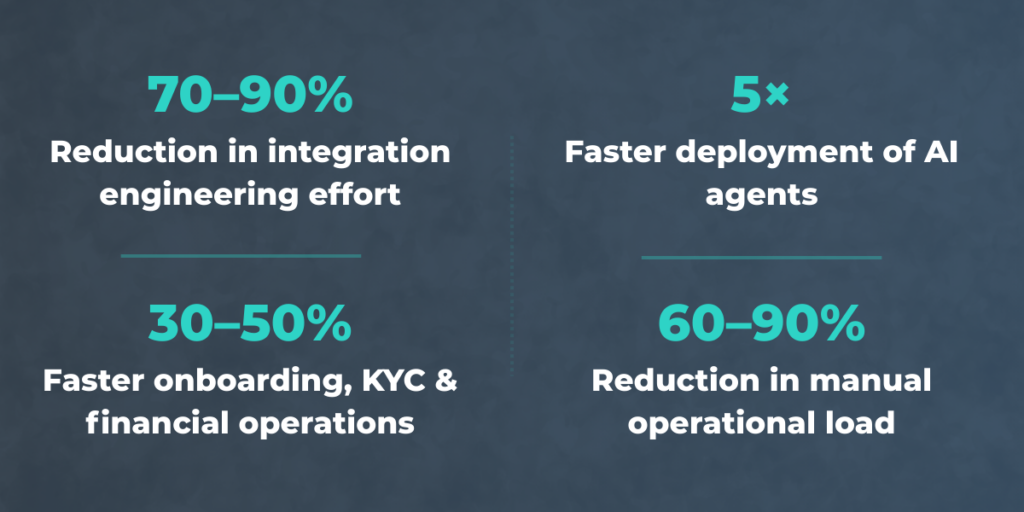
These aren’t theoretical projections. Karnataka Bank’s recent API modernization delivered 50% scalability increase and 30% operational cost reduction by shifting to a unified API orchestration layer.
The pattern holds across industries. When integration stops being the bottleneck, everything accelerates.
Why This Matters Now
The window for competitive advantage is narrowing.
Banks and fintechs are moving from AI pilots to production-scale deployment. The organizations that solve the integration layer first will deploy agents faster, automate more completely, and capture disproportionate value.
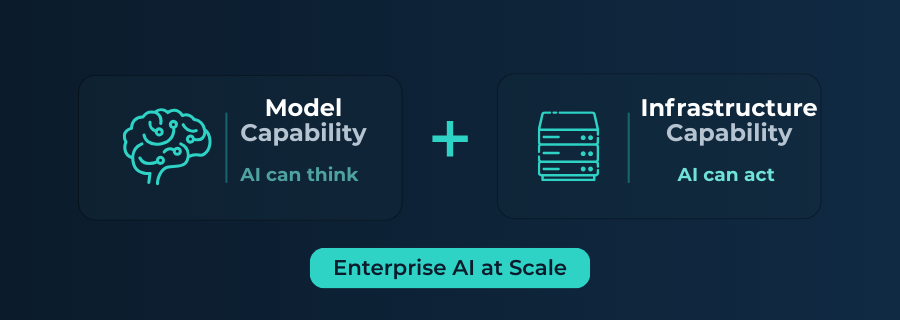
Enterprise AI requires both model capability AND infrastructure capability. Intelligent APIs bridge the gap.
The technology exists. MCP provides the standard. Platforms exist to operationalize it. The question is execution speed.
Companies still treating APIs as integration plumbing will spend 2026 the same way they spent 2025—stuck in pilot purgatory, watching engineering budgets disappear into custom integration work, unable to scale what works.
Companies treating APIs as an operating layer for AI will ship production agents while competitors are still writing integration code.
The Path Forward
Intelligent APIs require a platform approach, not a point-solution approach.
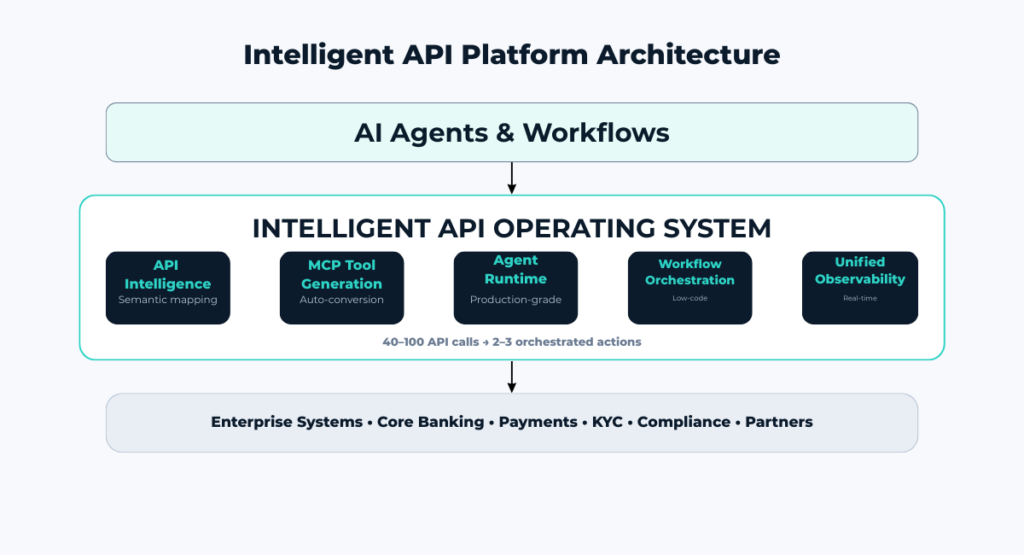
The Fyrii Intelligent API Operating System: unifying API intelligence, agent runtime, workflow orchestration, and observability
The core capabilities needed:
- Deep API intelligence. Continuous analysis of every API in your environment—routes, models, dependencies, usage patterns—producing a real-time semantic map.
- Automatic tool generation. One-click conversion of APIs to MCP-compatible tools with metadata-rich definitions and safe execution envelopes.
- Enterprise agent runtime. Production-grade infrastructure for agents to use Intelligent APIs, execute workflows, maintain state, and follow guardrails.
- Workflow orchestration. Low-code transformation of 40-100 API call chains into 2-3 orchestrated actions with error handling, retries, and event triggers.
- Unified observability. Real-time visibility across APIs, agents, workflows, and infrastructure in a single view.
This is the architecture Fyrii has built—the first Intelligent API Operating System designed to take enterprises from pilot purgatory to production-scale AI.
The Bottom Line
AI’s problem isn’t intelligence. It’s action.
The models work. The use cases are clear. The business value is proven. What’s missing is the infrastructure layer that lets AI agents safely, reliably, and observably interact with enterprise systems.
Intelligent APIs are that layer.
The enterprises that adopt them now will define the next generation of industry leaders. The ones that wait will keep asking why their AI pilots never scale.
Key Takeaways
- 95% of AI pilots fail—not due to model limitations, but infrastructure gaps
- Traditional APIs are static, opaque, and manually integrated—incompatible with AI agents
- Intelligent APIs self-describe, auto-convert to tools, and embed guardrails
- Organizations see 70-90% reduction in integration engineering with Intelligent API architectures
- 40% of enterprise apps will integrate AI agents by end of 2026—infrastructure decisions made now determine who captures value
Sources
- MIT Project NANDA — 95% of generative AI pilots fail to deliver rapid revenue acceleration. Fortune
- S&P Global — 42% of companies abandoned most AI initiatives in 2025, up from 17% in 2024. WorkOS
- McKinsey — Two-thirds of organizations stuck in pilot stage. CIO Dive
- ONEiO Research — Average enterprise uses 250-500+ applications. ONEiO
- Salesforce Research — 71% of applications remain unintegrated; 39% of developer time on custom integrations. ONEiO
- MuleSoft 2025 Connectivity Benchmark — Only 2% of organizations have integrated more than half their apps. Adalo
- Gartner — 40% of enterprise apps will integrate AI agents by end of 2026. ONEiO
- Postman 2025 State of API — 70% of developers aware of MCP, only 10% using regularly. Postman
- FinTech Weekly — MCP adoption across Stripe, Square, Shopify; Agentic AI Foundation formation. FinTech Weekly
Ready to Move Beyond Pilot Purgatory?
Learn how Fyrii’s Intelligent API Operating System can accelerate your AI deployment from months to weeks.